

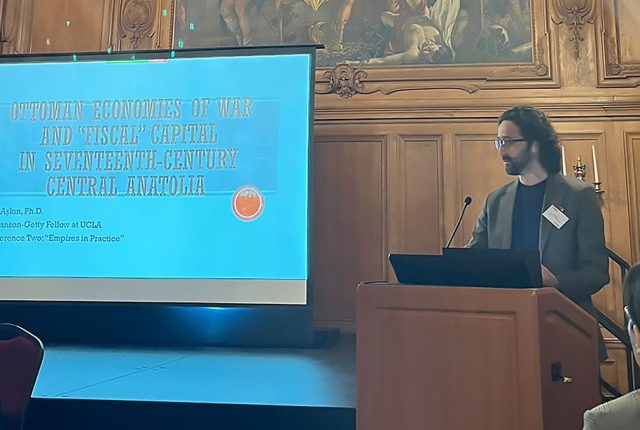
On March 6, 2026, I attended the second meeting in this year’s workshop series, Empires in Practice, following Empires of Thought in December 2025, as part of the Core Program Strange Synchronicities and Familiar Parallels in Asia, 1600–1800. With a third meeting, Empire of Things, planned for May, the series has already exceeded expectations and demonstrates the value of collaboration across the study of early modern empires. The organizers, Choon Hwee Koh, Meng Zhang, and Abhishek Kaicker, deserve particular praise for bringing this series together, as do the Clark Library and the Center for 17th– and 18th–Century Studies for their generous support.
This commitment to bringing together historians of different empires represents a significant generational effort. Building on earlier waves of comparative scholarship in the 1990s and early 2000s, shaped by both historical and social-scientific approaches, the series renews momentum for comparative work while opening new space for political economy and for reflecting on how these fields have evolved over time. It is also distinctive in its effort to build new factual, thematic, and conceptual bridges that may not have emerged in earlier phases, when dominant trends and questions, often without adequately engaging the material, intellectual, and archival richness of these fields, shaped the historiography.
A distinctive feature of the workshop was the exchange that began well in advance of the event. Participants circulated papers beforehand, enabling a level of close engagement often difficult to achieve in larger conferences. Across four thematic sessions, the papers demonstrated remarkable thematic and methodological breadth, as well as archival depth. They addressed imperial power at the local level, the entanglements of law and politics, the roles of merchants and administrative actors, and the relationship between finance and power. Each session benefited from generous and carefully chosen commentators, culminating in an illuminating roundtable discussion.
As a scholar of the early modern Ottoman Empire with a broad interest in resource extraction for military and fiscal institutions, it was a pleasure to share my work-in-progress based on research conducted during my time at UCLA, as I look forward to further exploring additional catalogues during my remaining time in Los Angeles. Alongside the intellectually stimulating questions and feedback I received, the engagement of Mughal and Qing scholars offered valuable insights into what we may—or may not—take for granted within our respective fields.
Among many illuminating conversations, I was particularly struck by two threads that emerged during the final roundtable. The first concerned the kinds of new “theories of change” that comparative work might generate alongside the creative discoveries it opens, points raised by Munis D. Faruqui (UC Berkeley) and Abdurrahman Atçıl (Sabancı University), respectively.
I look forward to formally acknowledging the generative impact of these conversations in my forthcoming publications and book.
-Anıl Aşkın, Ahmanson-Getty Postdoctoral Fellow 2025–26